

Dolin’s Ski Brigade Information Board
The destruction of Dolin’s Ski Brigade in Kuhmo is one of the most unusual events of the Winter War, and many different stories are associated with it. The most significant reason for the brigade’s destruction was probably the death of its commander, Colonel Dolin, during the early stages of the battle. The weather favoured the Finns, as temperatures dropped to around −20°C during the most intense phase of the fighting.
The Red Army began forming ski units in late 1939, eventually assembling approximately 46,000 troops with skiing skills. Dolin’s Ski Brigade was commanded by Colonel Vyacheslav Dmitrievich Dolin. Born in Moscow in 1901, he had taken part in the Russian Civil War. He completed his officer training at the Moscow Infantry School and served as an artillery commander in various military formations before the Winter War.
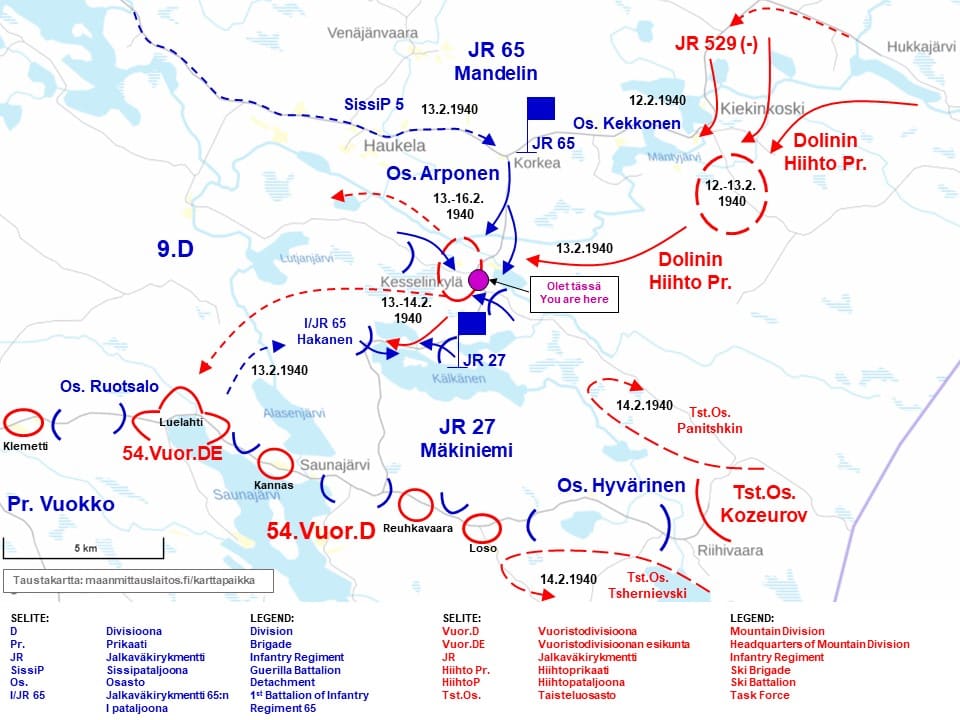
Dolin’s Ski Brigade was assembled near the Finnish border on 8 February from three ski battalions and an NKVD company. According to information obtained from prisoners of war, the brigade’s mission was to attack the Finnish rear from the direction of Kiekinkoski, break up the Finnish forces encircling the Soviet 54th Mountain Division, and then remain in support of the division. The brigade’s offensive was supported by the Soviet Air Force, which also provided radio communications. An infantry regiment and additional ski troops were also prepared to support the attack. Altogether, approximately 5,500 soldiers were assembled for the operation.
The first sightings of the brigade’s leading battalion at the Hukkajoki River were made as early as 2 February 1940. The main forces of the ski brigade joined up on 8–9 February, and the Finnish forward units withdrew from Hukkajoki to Kiekinkoski on 11 February. Supported by aircraft, the brigade attacked Kiekinkoski along several routes the following morning, forcing Detachment Kekkonen to withdraw. The brigade commander was killed that same morning, which was confirmed by an intercepted radio message. There are several different accounts of the circumstances of his death, but their accuracy remains uncertain.
The ski brigade cut the Finnish supply route north of Kesseli on 13 February. The supply units of Infantry Regiment 27 held their positions while surrounded south of Kesseli until 14 February, when contact with them was re-established from the north. The brigade’s leading battalion advanced to the Vetko isthmus, where it was destroyed in a Finnish counterattack on 14 February.
The ski brigade was unable to continue its advance towards Luelahti and was destroyed west of Kesseli between 15 and 16 February. The Red Army abandoned plans to commit additional forces because no further information was received about Dolin’s Ski Brigade’s advance. At the same time, the ski detachments advancing on both sides of the Saunajärvi road withdrew after suffering significant losses.
Of the approximately 1,800 men in the ski brigade, an estimated 1,500 were killed in four days of fighting in the Kesseli and Vetko areas. A total of 66 prisoners were taken, and 13 men are known to have reached the encircled Soviet forces. An estimated 50 men were evacuated by aircraft. In the patrol engagements that followed the decisive battle, approximately 200 more Soviet soldiers were killed, while the remnants of the brigade fled into the forests. Total Finnish losses in these battles have been estimated at around 100 killed.